Felipe Schmidt Fonseca is a researcher and advocate for social-environmental innovation and free/open-source technologies. As a design researcher he is working with open source greentech, critical circularity, participatory research & systems-thinking.
In June 2026, Ela Kagel and Felipe Schmidt Fonseca met online to share insights around repair & reuse and to explore Felipes work over the past decades. Here you can listen to their conversation:
“I’ve been working on material sovereignty for a quarter of a century”
Felipe, who was born and raised in Brazil, has been working for 25 years in fields related to open source culture, open science and what he would call material sovereignty. For the last seven years he has been living abroad, first in Scotland, then in Berlin, and he has now returned to Brazil. During his time in Europe, Felipe completed his PhD in Design at Northumbria University. His research is based on materiality in urban contexts, especially the reuse of objects and materials with a focus on collaborative, community-oriented forms of reuse. The idea of reuse has been central to Felipe’s work ever since.
Early experiments before “recycling” was even the word
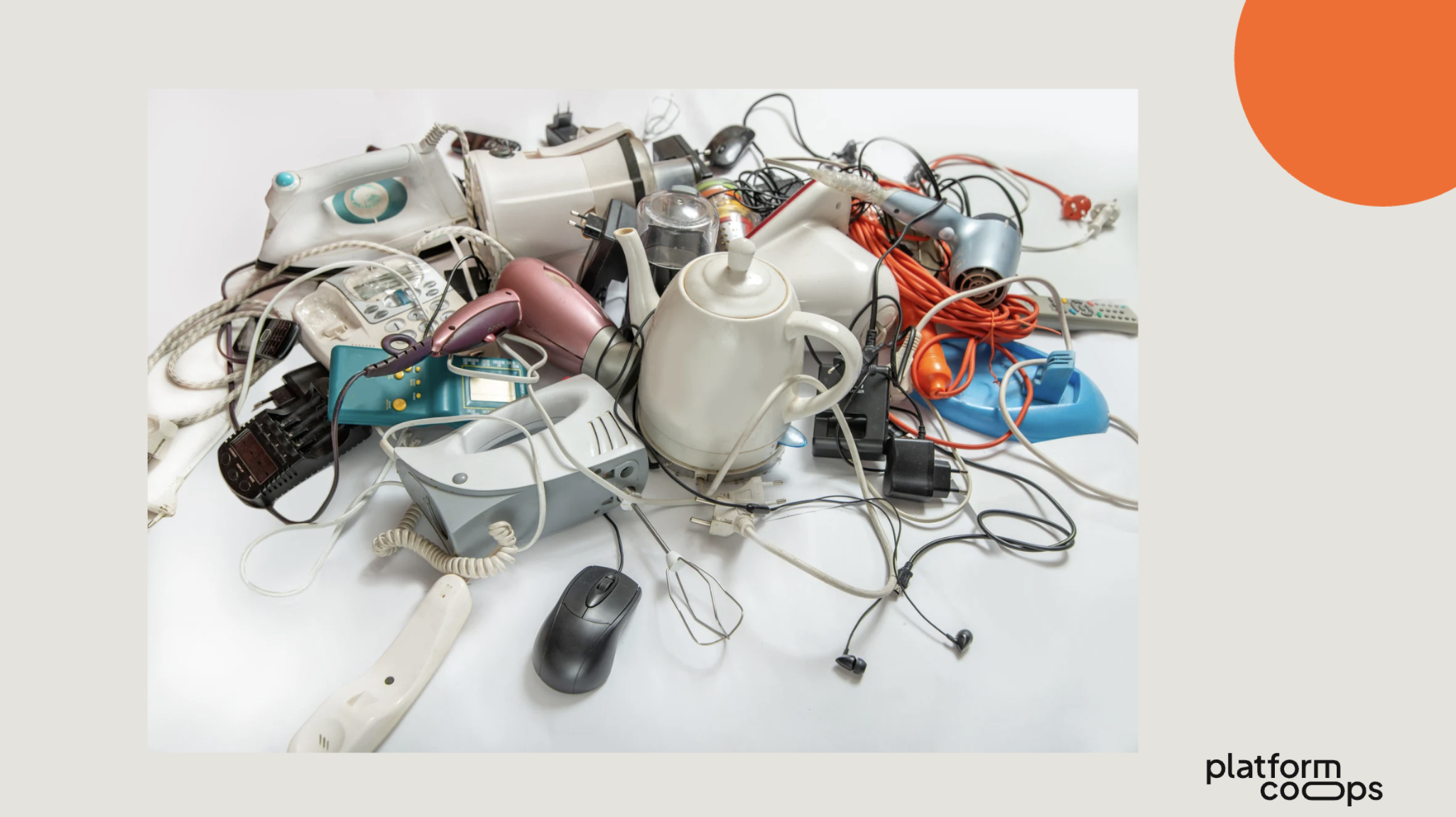
MetaReciglagem, one of Felipe’s first major projects started in 2002. „We were working with discarded electronic equipment, mostly computers. The goal was to make them usable again using free and open source software. This was long before mobile internet, before Wi-Fi was widespread, before 3G or 4G networks. Access to technology was very different then“, summarizes Felipe his personal roots in the area of recycling and reuse.
In Brazil at the time, many communities especially in urban peripheries relied on shared spaces to access computers and the internet. Municipal and state initiatives sometimes supported “open labs” where people could use equipment that would otherwise be too expensive. Felipe and his fellow recyclers would take donated or discarded machines and set up small networks in community spaces. Often, one stronger machine acted as a server, while others with limited memory or storage could still function as clients.
What they discovered was that this wasn’t just about technical efficiency — it was about access, dignity, and collective infrastructure.
Gambiarras: improvisation as knowledge
Over time, Felipe realized something deeper was happening. In Brazil, there is a concept called “gambiarra”, which might be translated into improvised, informal, sometimes makeshift solutions. Gambiarra is often associated with poverty or lack of access, and therefore seen negatively. However, you might also see it as the art of using improvisation and unconventional materials to solve everyday problems. So, in practice, gambiarra is also a form of tactical creativity: when you don’t have the right tools, materials, or time, you improvise solutions that still work. Felipe and his peers began to see gambiarra not as a deficit, but as a practice of intelligence under constraint.
Each culture in the world has similar practices and similar ways to engage in problem solving. What connects these practices is not lack, but resourcefulness: the ability to extend the life of materials and systems.
Rethinking circularity and consumption
Reuse practices also challenge dominant ideas about technology and consumption. In many industrial contexts, people are encouraged to be passive users — to consume devices they cannot repair and systems they cannot understand. Repair is often restricted or discouraged, sometimes even legally or economically (for example through warranty limitations).
This creates a deep dependency on industrial systems that we are not allowed to modify. At the same time, “circular economy” has become a popular concept in policy and industry. But there is a risk: it can become a form of greenwashing, where little changes in practice while language shifts to appear sustainable.
Still, there are also real opportunities. Policy frameworks such as the European Circular Economy Action Plan, the Right to Repair, and eco-design directives signal important shifts. The problem is speed — they are not fast enough compared to the scale of material extraction and waste production. So the question is not only how to recycle better, but: How do we extend the life and meaning of materials in ways that are socially and culturally grounded?
Material history, colonial extraction, and hidden flows
Any discussion about materials also needs to acknowledge history. Much of what became industrial prosperity in Europe was built on global extraction systems – including colonial trade, forced labor, and resource extraction from regions in the Global South. In Brazil, for example, the Atlantic Forest once covered a vast part of the coastline. Today, less than 10% remains. What was once a rich ecosystem has been transformed into plantations, cities, and industrial zones. Resources extracted from these systems — sugar, gold, coffee, timber — flowed into Europe and helped fuel industrialization.
These histories are not separate from today’s challenges. They are part of the same continuum: extraction, industrial production, waste, inequality and environmental collapse. Understanding this connection changes how we think about responsibility.
Education and the missing material literacy
One of the most surprising gaps today is how little this is addressed in education. „We talk about AI, innovation, and digital futures. However, we alomost never talk about material life cycles, ecological design, resource extraction or industrial impacts“ says Felipe in the interview. Even when sustainability is discussed, it is often reduced to individual behavior: recycling at home, reducing flights, or sorting waste. But the systemic dimension is often missing. Without this broader understanding, it becomes easy to feel that individuals are responsible for problems they did not create — while larger industrial systems remain unquestioned.
From artificial intelligence to collective intelligence
The language we use matters. Terms like “artificial intelligence” can obscure more than they reveal. They frame intelligence as something external, technical, and detached from culture or community. But intelligence is not only computational. It is also collective, embodied, cultural and ecological. A more useful framing might be collective intelligence — knowledge produced through shared practices, communities, and lived experience. This also opens up different ways of thinking about AI itself: not as a tool we simply interact with individually, but as something that could support more collective, relational ways of being.
Beyond solutions: convivality and shared presence
There is a growing sense, especially among younger generations, that traditional “solutions” are not enough. Climate action, policy frameworks, and technological fixes have not matched the scale of the crisis. „Perhaps the focus should shift slightly: Not only solving problems, but creating forms of conviviality as ways of being together“ suggests Felipe. Sometimes the most meaningful political act is not optimization or efficiency, but simply creating spaces where people can gather and repair and learn together. Even if some of the repair issues might not be fully solvable, the relationships formed in addressing them still matter.
Closing reflection: irreparable futures
A useful way to think about the present might be through the idea of “irreparable futures.” Not everything can be fixed. But repair is still important — not only of objects, but of relationships, systems, and imaginaries. Repair becomes a form of resistance: “To repair is to rebel.” It is not only about fixing things, but about questioning why they were designed to break in the first place. And perhaps more importantly, it is about staying connected: to each other, to materials, and to the histories that shaped the world we live in.
About Felipe Schmidt Fonseca
Felipe works with open source culture, material reuse, and collective infrastructures for sustainability. His practice spans research, design, and community-based projects focused on resource efficiency and post-extractive systems. He is active through initiatives such as Reuse City, Global Innovation Gathering (GIG) and various federated and decentralized networks. You can also check out his personal website here: https://is.efeefe.me/