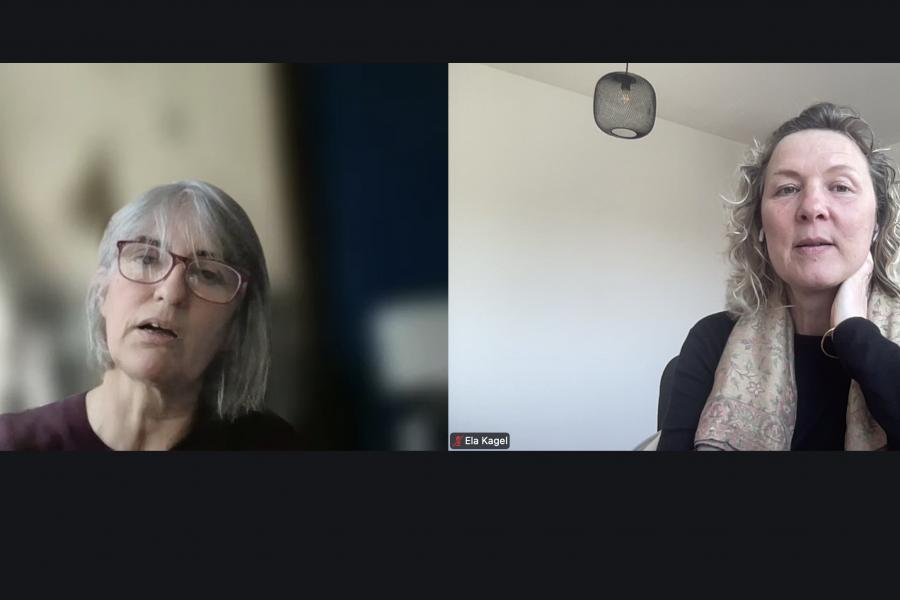
In this episode of our Klima Check-in Podcast, Shermin Voshmgir & Ela Kagel discuss various topics related to blockchain technology, crypto economics, and the tokenisation of natural resources. They explore the challenges and opportunities in implementing blockchain solutions for environmental conservation, particularly in agriculture and biodiversity protection. The conversation concludes with discussions about the limitations of current carbon markets and the need for more comprehensive approaches to incentivising sustainable practices, including the potential for direct farmer involvement and public education initiatives.
Listen to the recording: https://nextcloud.platformcoop.de/index.php/s/rsTfP3bxLBX8nG8
Blockchain and the Evolution of Money
Shermin discusses her work with blockchain technology and its social and economic impact, highlighting her research on crypto economics and the tokenisation of the economy. She expresses surprise at how many people still lack an understanding of what money actually is. Shermin shares her realisation that the form of money today is relatively new, having only existed since the 1970s. Shermin outlines her current projects, including her new podcast series on money patterns and a venture in Portugal involving the tokenisation of olive trees to create new value streams for farmers.
Barriers to Crypto Adoption
Shermin talks about the slow progress of crypto adoption, comparing it to the mainstream success of Facebook & highlightes the lack of financial literacy and historical understanding of money, which hinders innovation in the crypto space. She emphasizes the importance of teaching financial literacy systematically and the need for more network effects in crypto to drive real innovation. The conversation then shifts to Shermin’s recent work connecting the natural environment, the concept of the commons, and blockchain technology, with carbo certificates being a known testament to this integration.
Sustainable Farming and Carbon Credits
Shermin shares her experience managing an olive farm in Portugal, highlighting the challenges of traditional versus intensive agricultural practices. She explaines how modern farming methods prioritise efficiency over biodiversity, despite environmental benefits like water retention and pest control provided by natural terraces. She concludes that current agricultural subsidies and market mechanisms fail to adequately reward farmers for maintaining ecological practices, suggesting that carbon credits could provide a more equitable incentive system for sustainable farming.
Biodiversity in Carbon Markets
Shermin discusses the importance of biodiversity in relation to climate change and carbon markets, highlighting the need to change the narrative to include biodiversity in discussions about carbon certificates. She shares her personal experience as a farmer, noting the contrast between urban areas with concrete and her own olive garden, which naturally cools down and supports biodiversity. Shermin also mentions an EU initiative to find ways to incentivise biodiversity maintenance, as carbon markets alone are not sufficient. She has been working on a project to tokenise olive trees and give them blockchain identities, but the project was halted due to various reasons.
Tree Data Tracking Blockchain Project
Shermin talks about involving the use of hardware wallets and sensors to track tree data, including soil quality, water retention, and humidity levels. Experts would be needed to estimate tree age and type, which would be recorded on a blockchain as a „passport“ for each tree. The project would require collaboration with scientists to determine which measurements to take and how often, considering cost and practicality. The goal is to create a prototype that could be adapted for widespread use by farmers with limited technical knowledge. Additionally, working with policymakers and certification authorities like VERDA would be necessary to establish the value of the resulting certificates in carbon markets.
Enhancing Agricultural Incentives and Education
Shermin and Ela discuss the need to incentivise farmers and urban residents to maintain public goods like roads and trees, as they are not adequately rewarded by the market or government subsidies. Shermin shares her experience of learning to manage an olive grove and emphasises the importance of direct involvement in farming to understand its challenges. They explore ways to make ancient agricultural knowledge accessible to policymakers and the public, suggesting a combination of online communication and hands-on experience. Ela highlights the potential for individuals to gain more autonomy in producing their own energy and food, while Shermin notes the need for better education on these issues.
ReFi’s Limitations in Public Goods
Shermin reflects on the limitations of regenerative finance (ReFi) in creating markets for public goods, particularly its focus on carbon certificates, which is reductionist and does not address systemic issues. She highlights the need for more complex environmental certificates and incentivising actions like tree planting in cities and biodiversity protection. Shermin also mentions a project by Rebalance Earth that aims to tokenise biodiversity protection for elephants in Kenya, using public data to measure the carbon sink impact of forest elephants and incentivise their protection.
Carbon Market Certification Challenges
Shermin explains the challenges of certifying carbon markets, highlighting the lengthy and costly process required for gold standards. She emphasises the importance of stakeholder engagement and legal acceptance in valuing natural resources, drawing parallels to the critique of tokenising everything. Shermin clarifies that her work on olive tree certification is not related to tokenisation, but rather focuses on using blockchain technology for publicly verifiable proofs. She proposes hosting retreats and events at her farm to raise awareness about sustainable farming practices and the importance of connecting with nature.
Dieser Podcast wurde gefördert von dem Programm „Nachhaltig Wirken – Förderung gemeinwohlorientierter Unternehmen“ durch das Bundesministerium für Wirtschaft und Energie und die Europäische Union über den Europäischen Sozialfond Plus.
This podcast is funded by the program “Nachhaltig Wirken – Funding for Public-Benefit-Oriented Enterprises” by the German Federal Ministry for Economic Affairs and Energy and the European Union through the European Social Fund Plus (ESF Plus).